Opinion / Brand Strategy - Jason Zada
I've been saying this for over a decade. Nearly fifteen years of the same conversation with CMOs, brand leads, and marketing execs who would nod along, agree with everything I said, and then go back to buying 30-second spots.
Back in 2016, I wrote a piece for Adweek called "Why It's Time to Kill Advertising as We Know It and Start Building Storyworlds." The argument was simple: stop interrupting people. Stop renting audiences that belong to someone else. Build your own world. Own the IP. Become the studio.
The response was enthusiastic and then nothing. Because here's what I eventually understood: it wasn't that brands disagreed. It was that the idea was terrifying.
And honestly? That fear made sense. Until now.
But before we get into why the moment has finally arrived, I want to make one distinction that I think the industry has been getting wrong for years. We keep calling it "branded entertainment." That framing is backwards — and it matters more than it sounds. Branded entertainment says you're decorating someone else's story with your logo. Entertainment by brands says you are the studio. You own the world. You built the mythology. That's not a semantic tweak. That's an entirely different business model — and it's the one that actually compounds in value over time.
Let's Name the Fear
When a brand hears "become an entertainment studio," the images that come to mind are not good ones. A $200 million movie that nobody watched. A branded scripted series that got buried on a streaming platform. An expensive vanity project that a new CMO killed six months in.
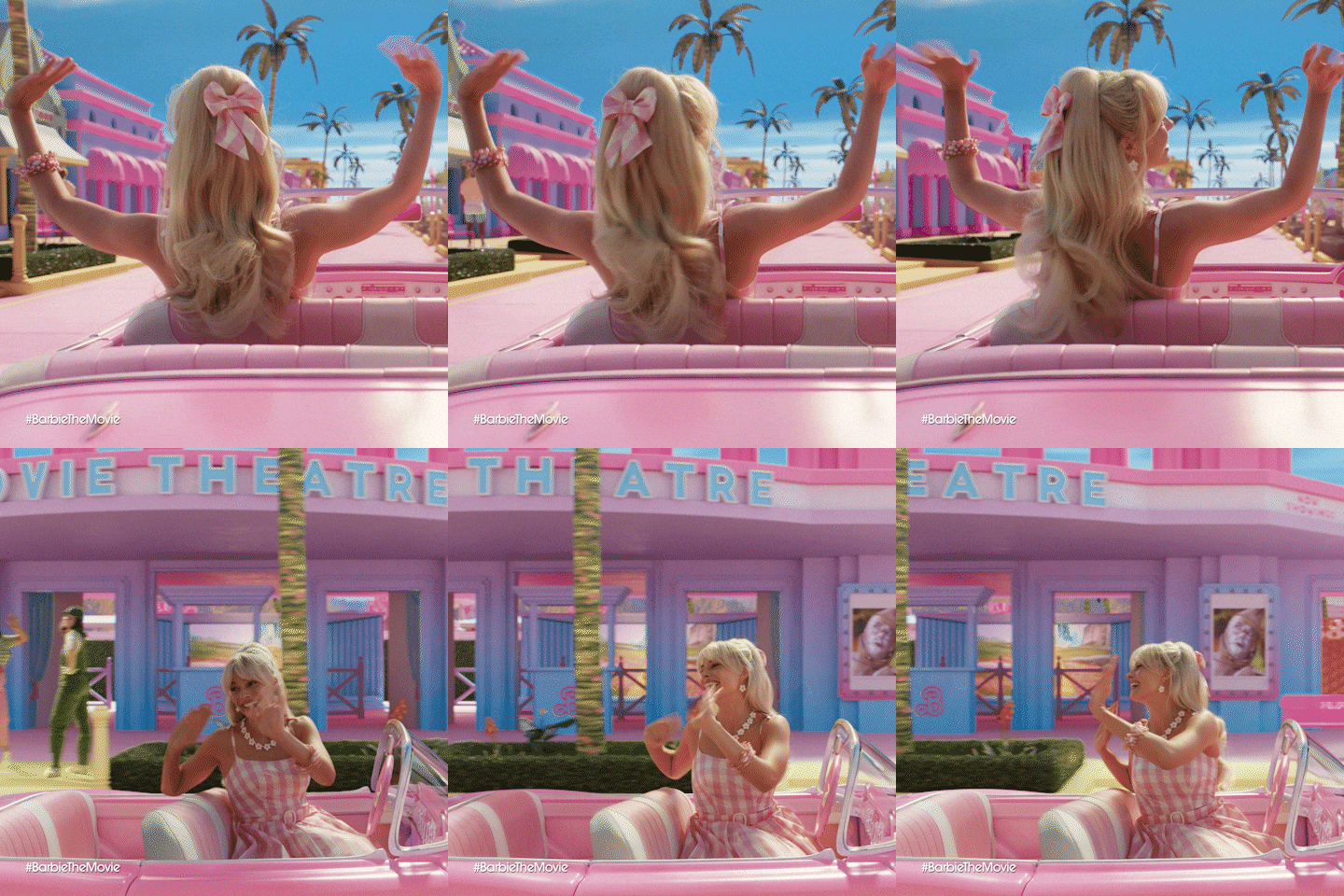
Those fears are legitimate. But they're based on an old model — one where becoming an entertainment company meant hiring a Hollywood crew, cutting massive checks to writers and directors, and hoping the finished product landed. Where the barrier to entry was the same for a brand as it was for a major studio. Where the only proof point anyone could point to was the Barbie movie, and not every brand has Mattel's decades of IP to draw from.
There's also a subtler fear underneath all of it — what I'd call brand envy. Every CMO thinks another brand is cooler than theirs. Coca-Cola thinks people would watch something from Nike. Nike thinks people would watch something from Red Bull. Nobody thinks audiences will show up for them. And yet Dove — the soap company — produced an Oscar-winning animated short. Airbnb independently produced a documentary that premiered at Tribeca. The fear isn't rational. It's just familiar.
And here's the historical irony: brands were already running this playbook a century ago before the ad-tech era interrupted it. Procter & Gamble produced soap operas. Hallmark ran its own TV channel. BMW launched a short film series directed by Guy Ritchie and Ang Lee that racked up over 100 million views. The model worked. Then the cookie came along and everyone got distracted by targeting. Now the cookie is gone — and the original playbook is back, with better tools than ever.
That model is not what I'm talking about. And it's not the model that's winning right now.
Look at the job boards and you can see the industry feeling its way toward something new. A December 2025 Wall Street Journal investigation found the word "storyteller" had doubled in LinkedIn job postings in a single year — 50,000 marketing listings, 20,000 communications roles. Executives mentioned "storytelling" on earnings calls 469 times in 2025, up from just 147 times in 2015. The thread discussing the article racked up 1.7 million views in a day. One of the most-liked replies cut right to it: "Storytelling starts before the product is ever conceived — the idea you can bolt it on after the fact is a giant myth." Exactly. And the same logic applies here. You can't hire your way into the entertainment era. You have to build your way in.
The new model is about brands becoming the financiers, the co-creators, and the IP owners — working with studios like Secret Level that were built from the ground up to make this transition possible, affordable, and fast. The entry point is lower than it's ever been. The upside is higher than it's ever been. What's missing, for most brands, is just the courage to start.
The System That Made the Old Model Viable Is Gone
Here's the harder truth: the fear of becoming a studio is now less dangerous than the alternative.
For decades, the advertising machine ran on two things — captive audiences and surveillance-grade targeting. Television had appointment viewing. Digital had the cookie, that tiny data exhaust trail that let advertisers follow you across the internet and serve you ads for the shoes you looked at twice.
Both are effectively gone. YouTube alone now outstrips traditional linear networks, grabbing a 12.5% share of U.S. TV viewership. Nobody is sitting through commercials to get to the thing they actually want to watch. And on the data side, Safari and Firefox already block third-party cookies by default, and privacy-first marketing is no longer optional. The tracking infrastructure that made scattershot digital advertising feel precise is collapsing.
The old playbook — interrupt, target, repeat — is getting harder and more expensive to run every year. The brands still betting on it aren't playing it safe. They're just deferring the reckoning.
And here's the other problem nobody talks about enough: even when the old model technically works, it's always late. Since the dawn of the internet, brands have been chasing culture — seeing what resonates, spinning up a brief, going through production, and finally releasing something by the time the moment has moved on. The gap between "this is culturally relevant right now" and "our campaign is ready" has always been the dirty secret of the industry. You can't buy your way into a moment you've already missed.
"Stop renting other people's audiences. The question isn't whether brands should be in the entertainment business. It's whether they can afford not to be."
The Ones Who Stopped Being Afraid
A handful of brands got over the fear early — and they're the ones everyone else is now studying.
Red Bull didn't build a media arm. They built a cultural engine — producing films, documentaries, and live events that sustain relevance independently of the product itself. You could strip the logo off half their content and it would still have an audience. That's not marketing. That's owned IP.
Dick's Sporting Goods built an internal entertainment studio that's won Sports Emmys. AB inBev signed an unprecedented deal with Netflix, embedding its brands inside Netflix's push into live sports and getting early access to placement in shows and films. That's not a sponsorship. That's infrastructure.
And in January, Gap did something I genuinely didn't expect to see this soon. They created a brand new C-suite role — Chief Entertainment Officer — and hired a former Paramount executive to fill it. The role spans music, television, film, sports, gaming, consumer products, and cultural collaborations. They're opening an office on Sunset Boulevard to physically embed themselves in the entertainment ecosystem.
Gap's CEO Richard Dickson put it plainly: "Fashion is entertainment, and today's customers aren't just buying apparel, they're buying into brands that tell compelling stories and drive cultural conversations."
That's not a marketing strategy. That's a declaration about what kind of company Gap intends to be. And it signals something important about the new skill set required — distribution strategy, licensing deals, IP development, partnership structures. That's a huge part of what a Chief Entertainment Officer actually does. It's not a content job. It's a business development job.
The Barrier Is Lower Than You Think — If You Have the Right Partner
Throughout 2024, LVMH launched 22 Montaigne Entertainment, Starbucks stood up Starbucks Studios, and Chick-fil-A announced original programming. At the same time, major streamers ordered 24% fewer first-run scripted titles in the first half of 2025 than the year before. Hollywood is actively looking for brand partners with money and stories worth telling. The gates are open in a way they have never been.
But here's where I want to push back on the framing most brands are still using: you don't have to build a studio from scratch. You don't have to hire a hundred-person production team or greenlight a feature film on your first swing. The entry point into this world is much more accessible than that — if you're working with a company that was built specifically to take you there.
Brands can fund entertainment. They can co-develop IP. They can build storyworlds — characters, universes, narratives — that live independent of any single campaign or product launch, and that compound in value over time. The goal isn't to make a really good branded documentary. The goal is to own something. Mythology that fans keep coming back to. IP that opens licensing deals, sequels, partnerships, merchandise. That's what the brands winning this era are actually building.
Secret Level was built specifically for this. An AI-native entertainment studio designed to walk brands into this new era — helping them develop original IP, build storyworlds, fund and produce entertainment, at a speed and cost that was simply impossible before. Not a production company that does branded content on the side. The entire mission is helping brands stop renting and start owning.
AI Doesn't Just Lower the Cost. It Lets You Move at the Speed of Culture.
When I wrote that 2016 Adweek piece, the economics of becoming an entertainment company were brutal for most brands even if they had the courage to try. A scripted series could run tens of millions. Development cycles were measured in years. The risk of sinking that kind of capital into something that didn't work was genuinely prohibitive. And even when brands pulled it off, they were still fighting the clock — by the time the work was done, the cultural moment it was chasing had often already passed.
AI breaks both of those problems at once.
Secret Level has been pushing the limits of what's possible — using AI to produce cinematic work at a quality and speed that simply didn’t exist two years ago. Projects that would have taken months and millions can now be developed, tested, and refined in weeks. But the bigger unlock isn't the massive efficiency gains. It's the ability to actually keep up with culture — to see what's resonating, move on it immediately, and be part of the conversation while it's still happening rather than six months after the fact.
That's the thing that changes everything for brands. Not just massive efficiency. The ability to move at the speed of culture for the first time ever.
A brand can now develop original IP, put it in front of an audience, learn in real time, and iterate — the same way a tech company ships and improves a product — rather than betting everything on one expensive, slow-moving campaign. The fear of the big swing gets a lot smaller when you can take fifty fast swings first, each one more informed than the last.
This is why the vision is simple: every brand should have its own AI Hollywood studio. Not as a metaphor. As a real operating model — a creative infrastructure that can concept, develop, produce, and distribute entertainment fast enough to actually matter, building genuine audience relationships and IP that compounds over time. The technology exists. The Hollywood partnerships are available. The audiences are waiting. Secret Level was built to be exactly that guide.
The Window Is Open. It Won't Stay That Way.
The brands moving now — Gap, AB InBev, LVMH and others — are building a lead that will be very hard to close. Entertainment IP compounds. Cultural trust compounds. The audience you build over five years of telling great stories is not something a competitor can buy their way into overnight.
I've been on this soapbox long enough to feel genuine satisfaction watching the industry finally arrive at the same conclusion. But I'll say what I said in 2016, just with more urgency and a clearer path forward: stop renting. Start building.
Entertainment by brands isn't a replacement for the existing commercial model — ads, media buying, brand positioning all still have their place. But they're no longer enough on their own. The era of entertainment by brands is here as a parallel track, a compounding asset that builds something ads never could: owned mythology, real audience relationships, IP that grows in value over time. Brands as the creators. Brands as the financiers. Brands as the studios. And for the ones willing to build that alongside their existing playbook — with the right partner, the right creative infrastructure, and the right long-term ambition — this is the biggest opportunity in the history of marketing.
The scary part isn't becoming an entertainment studio. The scary part is watching someone else do it first.
-
Jason Zada is the Founder and CCO of Secret Level, an AI-native entertainment studio built to help brands develop original IP, build storyworlds, and step into the entertainment era. He was named to the Ad Age Tech Power List in 2025. His 2016 Adweek essay, "Why It's Time to Kill Advertising as We Know It and Start Building Storyworlds," called this moment before most of the industry was ready to hear it.